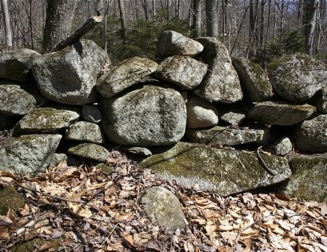
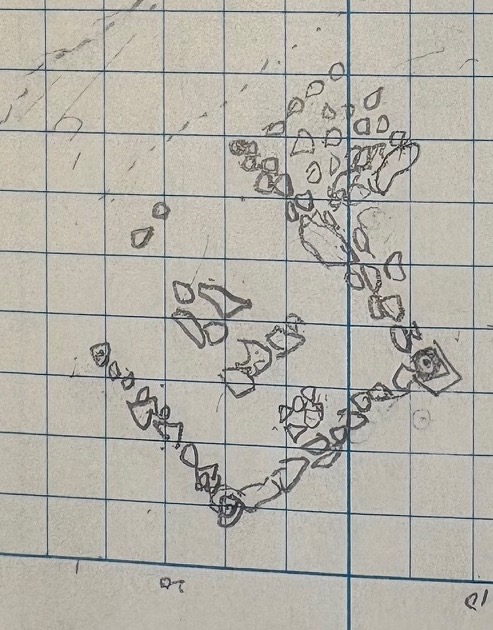
Thirty-six years ago in 1990, I was just getting started thinking about stone walls. In that same year, the Center for Field Research at Earthwatch Institute asked me to propose an expedition to New England to investigate what early pioneering walls were like relative to those of later established farms and estates. With that plan in the works for an expedition in April of 1992, I went on sabbatical at Dartmouth College for the 1991-1992 academic year. By October, I had learned about a legendary place called Tinkhamtown, a rumored settlement with a “lost” graveyard located somewhere in the remote, now completely forested, southeastern corner of Lyme, New Hampshire. By November, the New York Times had sent a reporter and photographer up to see what I was up to. The result was an article by Keith Schneider published on November 17, 1991 with the provocative and misleading title “Scholar Looks at Quaint Stone Walls and Sees Pioneer’s Garbage Heaps.” To give you sense of the article, consider this quote: “Gingerly treading on ideological ground hallowed by poets and artists, the 40-year-old scientist, Prof. Robert M. Thorson, is offering a theory that could open new perspectives on the ecological factors that influenced the behavior of New England’s pioneering farm families. Yesterday’s Beer Can?”
“The hate mail poured out of stamped envelopes because this epoch predated my access to the internet. I was also denounced by the local press, most notably the New Hampshire Sunday edition of the state’s largest newspaper, the Manchester Union Leader. I stood my ground because I had never used the word “garbage,” and because walls, by definition, cannot be heaps. My main conclusion, however, remains valid today: that most early walls on pioneering walls were “linear landfills” for disposing waste rock. “Those on properties that continued to be farmed after the pioneering stage, served the additional subsequent purposes of marking boundaries, making fences, and ornamenting properties with architecture. These are the ones we care about most.”
The quotes above come from the text of a book manuscript I submitted this spring, thirty six years after our successful and fascinating expedition. It’s already under contract to the University of Massachusetts Press and out for review with Brian Halley as editor. Why the 36-year t delay? Let’s start by saying that I’m no longer the “forty-year-old scientist” who had no idea he would spend decades working on stone walls. Now that I’m in my mid seventies, the time has come to finish several outstanding projects before it’s too late. I thought I would use this blog post to let my readers know what’s coming down the pike. The word “pike” is a play on words for the Grafton Turnpike, which provided access to the country I write about. It opened in 1810 and closed by 1847, putting a narrow time bracket around my project.
I’m keeping my fingers crossed as I await the results of anonymous peer review.