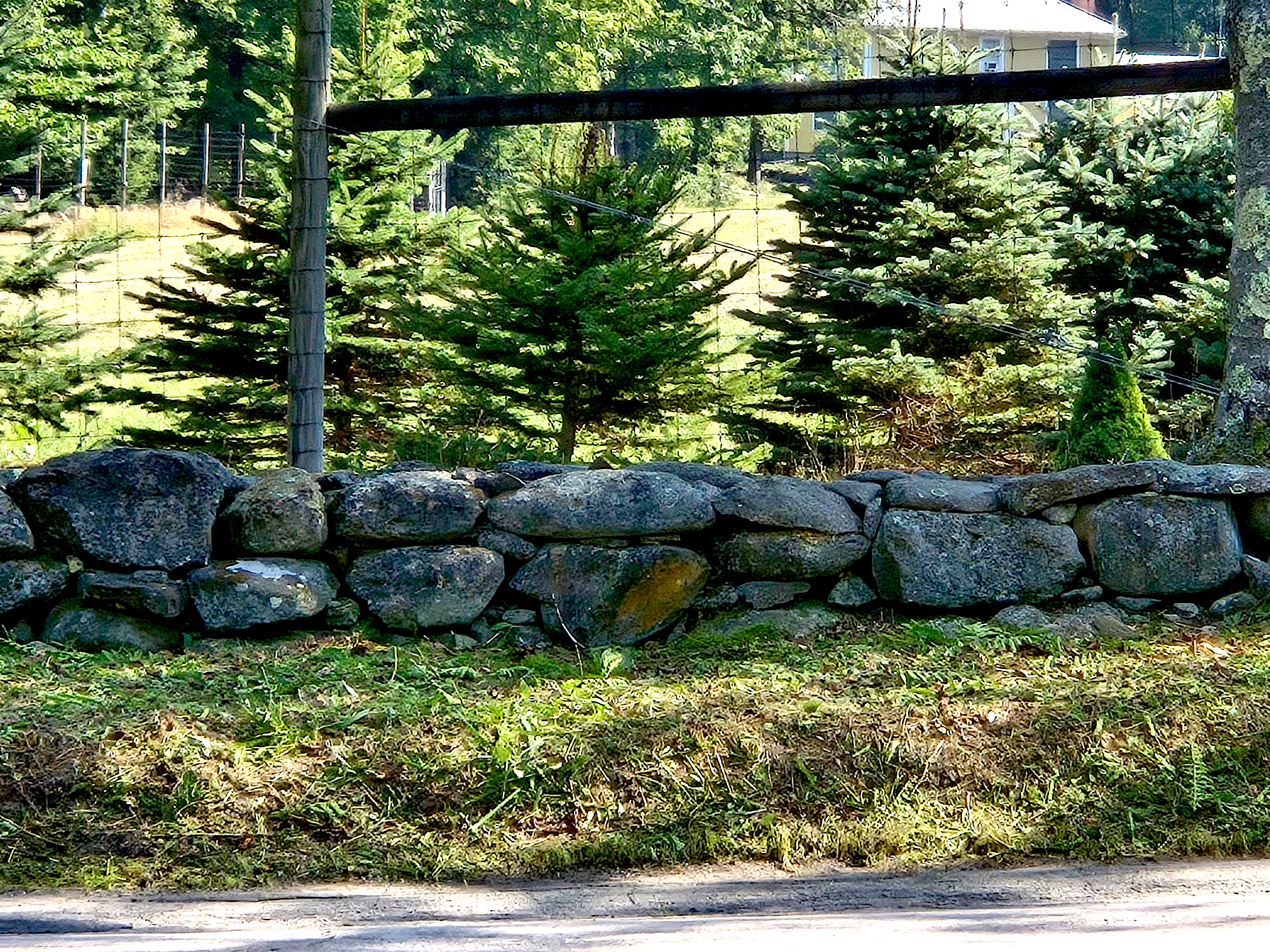
One of the things I do at the Stone Wall Initiative is to respond to queries from around the world. One recent query from the rural town of Jaffrey, New Hampshire piqued my interest about the relationship between stone walls and scenic roads. My correspondent claimed that: “We are aware that stone walls are protected by NH law, but don’t believe the ability to view a wall is protected.” This sentence stopped me in mid-thought. It seems that the legal protection refers to the material/archaeological aspects, not its visibility or aesthetics.
Of course, the idea that we need to see a scenic wall struck me as obvious. Apparently, not so. In New Hampshire, these are defined legally, rather than visually. Their 2025 New Hampshire Revised Statutes — Title XX, Chapter 231, Section 157 – Scenic Roads; Designation — read: “Any road in a town, other than a class I or class II highway, may be designated as a scenic road” through a carefully specified process in which towns vote after petitions from at least 10 abutting owners after being given due notice. This made perfect sense. But when I tried to find a state definition of scenic road that might involve being scenic, I came up empty.
This is where the automatic AI Overview of my Google Chrome internet browser came to my rescue. It informed me that Jaffrey has one officially approved roadway — a section of Thorndike Pond Road (formerly Slade Road) between Gilson Road and the Dublin town border. Diving into the town’s rules for Traffic and Transportation, I learned that the scenic road designation requires only that “except in emergency situations, there shall be no tree cutting or alteration of stone walls within the right of way without approval of the Planning Board, after a duly-noticed public hearing. The law does not affect the rights of individual property owners.” This makes sense as well, but it still doesn’t define a scenic road with respect to scenery. Rather, it points out actions that can’t be done. Luckily, the AI Overview defines a scenic road based on scenery: a “local, town-designated roadway that preserves its rural, geographic, and historical character.”
My correspondent wants to actually see his roadside walls, not just know they are present. He also wants them protected from the prying ravages of aggressive roadside vegetation. So, he keeps them clear on his rural class V road, which is partially gravel. Ideally, he would like his neighbor on the opposite side of the road to do the same. Though walls on both sides are cleared twice-per-year by town crews cutting of the right-of-way, his neighbor’s walls are quickly “overgrown by buckthorn, bracken, and other invasive plants.”
As a landowner, the neighbor has the right to let keep his/her wall in the dark for much of the year. Apparently, this would be allowed even if the road were designated a scenic road, because the town specifies only that there can be no “alteration of stone walls.” This raises the question: What is alteration? Alteration by who or what? If I were an attorney, I could read this both ways. Is letting the vegetation have its way an alteration? Or is keeping the vegetation clear an alteration? I don’t know. And us cutting tree saplings the same as cutting mature trees?
Apparently, “the town retains the right to maintain the ROW for public benefit?” So if they decide to keep the neighbor’s wall clear, they would be using taxpayer funds to clear a wall the owner does not want cleared. this is the very definition of a conundrum.
What I do know about the New England landscape is that stone walls and scenic roads often go hand in hand. I even wrote a paragraph about this issue of “context” in a 2025 journal article titled “Conserving the Historic Stone Walls of New England,” published in The Public Historian (Vol. 47, No. 1, pp. 101-119). Quoted it in full from page 112: “Many New England roads are the final outcome of a long-term chain of contingent processes that began with a footpath. Heavy use, especially by livestock and wheeled vehicles, compacted the soil, which deepened and intensified frost heaving and enhanced runoff erosion. These processes concentrated stone in the travel zone, creating obstacles that were moved aside, either to be stacked above grade or to be used as cut-and-fill retaining walls. Long-term use resulted on the simultaneous deepening of the roadbed through erosion and the upward growth of adjacent flanking walls to create what in Britain is a landform called a holloway, derived from the Old English “hola weg” or sunken road. Other scenic roads were created as straight lines along the edges of pre-existing walled properties and (or) were “laid out” with parallel stone walls, often with a specified width of two rods or four rods.”
My preference is to keep roadside walls clear for the common good. Individuals may own parcels of land. But, as Ralph Waldo Emerson pointed out in his pathbreaking book Nature, nobody owns the landscape.